Formby Asparagus Trail
Liverpool & Lancashire
The Asparagus Trail was installed in 2015 to showcase the close connection the site has to growing asparagus at Formby, and how this once common practice has shaped the landscape here. The route takes you around old asparagus fields, as well as highlighting the few fields left in cultivation. There are picnic tables along the way, as well as shorter and longer routes to extend your walk.
Near to
FormbyStart point
National Trust Formby Victoria Road car park, Victoria Road, Formby, Merseyside, L37 1LJ. Grid reference: SD 27997 08208Trail information
Address
L37 1LJ
By trainLocal Merseyrail services run every 15 minutes to Freshfield train station, which is approximately 3/4 mile from the entrance to Victoria Road car park. National services run to Liverpool Lime Street in Liverpool city centre, which is approximately 14 miles away.
On footThe start of the trail can be gained by walking in from the Victoria Road entrance. See our Accessibility Guide for more information about this entrance.
By busLocal buses in Formby run from Formby train station, and services F4 and F5 pass close by the foot entrance on Victoria Road.
CyclingCycle racks can be found in the Victoria Road car park.
By roadFormby town can be accessed from the Formby bypass (A565) easily if coming from either Southport or Switch Island, at the end of the M57 and M58. These motorways connect to the M62 and M6 respectively.
- Dogs
Suitable for dogs under close control.
- Car park
Victoria Road car park has limited parking spaces and can get very busy on sunny days. Please use public transport where possible. See "Getting Here" for more information on public transport options.
- Toilet
Male, female, and a toilet with accessible features can be found at Victoria Road car park.
- Picnic area
Two picnic areas are on the route, one at the beginning, and another just south of the start point.
- Cycle parking
Cycle racks are available at Victoria Road car park.
Sand wheelchairs are available to borrow for free. Please see our Accessibility Guide for details of how to rent them.
- Designated parking
Blue badge parking available at Victoria Road car park.
- Accessible toilet
Toilet with accessible features at Victoria Road car park.
- Seating available
11 benches are on the route, with a maximum distance of 300m between two.
- Steps/uneven terrain
The terrain is undulating with a maximum gradient of 1:8.
- Wheelchairs available
Sand wheelchairs are available to borrow for free. Please see our Accessibility Guide for details of how to rent them.
The terrain of the asparagus trail varies greatly, with some sections only bare sand, others surfaced with stone, and many sections with green plastic mesh.
The route is generally flat, though a few sections have gradients up to 1:8.
Total stages: 11
Total stages: 11
Start point
National Trust Formby Victoria Road car park, Victoria Road, Formby, Merseyside, L37 1LJ. Grid reference: SD 27997 08208
Stage 1
To complete the trail in an anti-clockwise direction, head south-west down the stone footpath into the woodlands. The track here is steep (up to 1:8), with a compacted surface of up to 20mm stone size. The footpath is 3m wide for around 50m before the edging boards end and the cambered stone footpath leads you through the mature deciduous woodland. Parts of this woodland section can be muddy in winter and after heavy rainfall so take extra care if visiting during these times.
Look out for red squirrels
The woodland here is mature and fairly varied in terms of species compared to other parts of site. You’ll find the usual species of pine trees, but interspersed amongst elm, ash, sycamore, poplar, oak and birch.
Stage 2
After leaving the woodland, turn right (west) and follow the stone footpath towards and then alongside the base of the sand dunes, heading south. The path surface is made up of up to 20mm size stones, though some sections can be covered in a thin layer of wind-blown sand due to being so close to the dunes.
Look out for old asparagus fields
The view looking south-east once leaving the woodland takes in two old asparagus fields which used to be farmed by Jimmy Lowe. The flat landscape still shows glimpses of this history and wild asparagus is still present in the fields and the dune grassland along the whole coastline.
Stage 3
Follow the pink waymarkers through the mature pine woodland and around the old asparagus field at Sandfield Farm. The surface is level and compacted stone, though the north-west corner of the asparagus field has a gradient of 1:8. After around 600m you will reach Blundell Avenue.
Look out for wild asparagus
The mature pine woodland was planted over a century ago with the intention that it would be sold for timber, and also to protect the asparagus fields from the worst of the harsh coastal weather conditions. Though still protecting the old asparagus field, the dunes have rolled back significantly since the trees were planted and are now butting up against the mature pine woodland, a process called coastal squeeze.
Stage 4
At the corner of Blundell Avenue, head left (east) along the road, taking care as it is used by pedestrians, cyclists, horse-riders and vehicles on a regular basis. Follow the road for around 500m.
Look out for red squirrels
To move from one tree to another, red squirrels will jump from the canopy of the trees to another on the other side of the road, or risk coming down and across the road. From the road, it is easy to see the difference between the two main species of pine tree. The taller, straighter Corsican pines dominate the woodland on the northern side of the road, and with a redder bark, more curved growth, and generally shorter in height, Scots pine dominate the southern side.
Stage 5
To see a field still in cultivation, head south on to Larkhill Field, or skip to step 6. This field track is not surfaced, and is predominantly grassland, with some bare sandy patches. After around 200m, you reach a wooden kissing gate (maximum width 108cm). Head through the gate, and after another 30m you will reach the viewpoint and interpretation board about the asparagus field. Head back to Blundell Avenue to continue the trail.
Look out for butterflies
On the southern side of the kissing gate is Larkhill Heath, a small area of rare dune heath which hosts several rare insects. The heathland can only form here after many centuries, whereby a combination of nutrients being leached by rainwater and consistent grazing pressure creates acidic, nutrient poor soils. This allows species such as heather to grow. In late summer, the purples and pinks of the heathland attract butterflies such as green hairstreak’s and painted lady’s.
Stage 6
Head north into the pine woodland from Blundell Avenue, roughly opposite the track down to Larkhill Field. The stone surface here is relatively level and leads quickly eastwards before straightening up and heading north again.
Look out for blackberries
The relatively spacious mature trees here allow for a diverse understory of species, including holly, birch, and hawthorn, with blackberries from the bramble providing a tasty food resource for small birds, and for visitors!
Stage 7
Continue north along the green plastic mesh surface for around 100m before the path bends to the left, up and over a steep historic dune that is now mature pine woodland, and into an open field. This latter part is not surfaced and has a gradient of 1:8.
Look out for rabbits
Another old asparagus field can be seen as you walk along the plastic mesh on your left-hand side. Though now unfenced and left to be grazed by wildlife such as rabbits, it is being reclaimed by the surrounding woodland, particularly the poplar trees that are present on its western edge.
Stage 8
Continue along the stone footpath heading west towards the far end of the field, with the surface changing again from stone to green plastic mesh. The mesh can be fairly undulating with some steep crossfalls, so take extra care if using or pushing a wheelchair or pram along here.
Look out for pheasants
This field is another historic asparagus field that has since been left for nature to reclaim. The grassland here offers a welcome glade amongst the dense and dark pine plantations that surround it. Locally, this field is called Wheels Field, named because of the old metal wheels which adorned the field for many years, and were all that was left of the farming machinery that was once used in the field.
Stage 9
Continue along the footpath that leads from the western end of Wheels Field, through the scrubland and towards the large asparagus fields that you first spotted at step 2. From here, head north (right) along the eastern edge of the most northern asparagus field to meet the family picnic site.
Look out for buzzards
Rabbits are very common in both of the large, old asparagus fields, due to the lack of natural predators. That being said, buzzards nest in the nearby woodland and can be heard calling in the skies most days. Making up a large percentage of the buzzard’s diet, rabbits graze the grassland cautiously, keeping one eye on the grass and one eye on the sky!
Stage 10
To finish the trail, you can head west for around 300m along the green plastic mesh that runs along the northern side of the asparagus field to rejoin the trail at step 2. From here, return along the woodland path to the original starting point. However, you can also finish the asparagus trail by entering the family picnic site.
Stage 11
To complete the asparagus trail via the family picnic site, head north through the middle of the picnic site, which brings you out into the woodlands. From here, travel west across bare sand to meet the woodland footpath that you began the trail on and cut back up the slope to reach the starting point.
End point
Finish the trail at the Victoria Road information trailer in the woodland car park. Grid reference: SD 27997 08208
Trail map
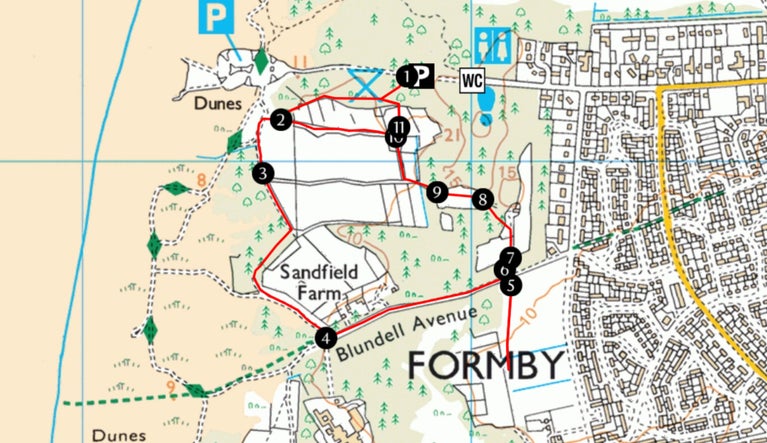
Formby Asparagus Trail | © Crown copyright and database rights 2013 Ordnance Survey
Get in touch
National Trust Formby Countryside Office, Blundell Avenue, Formby, Liverpool, L37 1PH
Our partners

We’ve partnered with Cotswold Outdoor to help everyone make the most of their time outdoors in the places we care for.
