Kirklake Path
Liverpool & Lancashire
The quickest route to the beach from Formby train station, this 0.6 mile linear route takes you through mature pine woodland, across dune grassland and over mobile sand dunes to reach the beautiful Formby coastline, and all without having to cross any roads or go via the car parks.
Near to
FormbyStart point
Kirklake Corner entrance to National Trust Formby. The nearest post code is L37 2DF and the grid reference is SD 28080 06793.Trail information
Difficulty
Full trail
DistanceMiles: 0.6 (km: 0.96)Address
L37 2DF
By trainLocal Merseyrail services run every 15 minutes to Formby train station, which is approximately 0.6 miles from the entrance at Kirklake Corner. National services run to Liverpool Lime Street in Liverpool city centre, which is approximately 14 miles away.
On footThe start of the trail can be gained by walking in from the Kirklake Corner entrance. See our Accessibility Guide for more information about this entrance.
By busLocal buses in Formby run from Formby train station, and the F3 service passes close by the entrance at Kirklake Corner.
CyclingCycle racks can be found next to the portable toilets at Lifeboat Road car park.
By roadFormby town can be accessed from the Formby bypass (A565) easily if coming from either Southport or Switch Island, at the end of the M57 and M58. These motorways connect to the M62 and M6 respectively.
- Dogs
Suitable for dogs under close control.
- Car park
Lifeboat Road car park has limited parking spaces and can get very busy on sunny days. Please use public transport where possible. See "Getting Here" for more information on public transport options.
- Toilet
Unisex portable toilets, and a portable toilet with accessible features can be found at Lifeboat Road car park.
- Cycle parking
Cycle racks can be found next to the portable toilets at Lifeboat Road car park.
Sand wheelchairs are available to borrow for free. Please see our Accessibility Guide for details of how to rent them.
- Designated parking
Each of the three bays at Lifeboat Road car park have accessible parking spaces.
- Accessible toilet
A portable toilet with accessible features can be found at Lifeboat Road car park.
- Seating available
The route has 3 benches on route, with a maximum distance of 350m between them.
- Steps/uneven terrain
The terrain is undulating with a maximum gradient of 1:6.
- Wheelchairs available
Sand wheelchairs are available to borrow for free. Please see our Accessibility Guide for details of how to rent them.
The majority of the footpath is surfaced with compacted stone (up to 40mm) but the last 500m is almost entirely bare sand so can make accessing the beach difficult. The gradients are also steep and in a few places are around 1:6.
The elevation drops steeply at the switchback not far from Kirklake Corner, then rises more gently on the opposite side. The final sand dune is steep however, and rises significantly (around 10m) before dropping again to reach the coastline.
Total stages: 6
Total stages: 6
Start point
Kirklake Corner entrance to National Trust Formby. The nearest post code is L37 2DF and the grid reference is SD 28080 06793.
Stage 1
Head west through the gap in the wooden fence (maximum gap is 113cm) and follow the compacted stone surfaced footpath (maximum stone size is 20mm) for around 200m.
Look out for mature pines
The mature pine woodland is some of the oldest at Formby. It is clear to see that the woodland is not natural, as the southern side of the footpath has clearly been planted in perfectly straight avenues, ideal for forestry purposes, but not natural! Red squirrels can often be seen in the treetops of these 100-year-old trees, feeding and making dreys (nests).
Stage 2
Continue heading west, down the switchbacks to the bottom of the slope. The gradient here is 1:6, and the crossfall in places can also be very steep so take extra care and use the wooden handrail.
Stage 3
At the bottom of the slope, take the path immediately opposite to continue heading west towards the beach. The surfaced footpath leads you up a gentler slope than that which you’ve just come down but is still fairly steep, around 1:8.
Look out for grey poplar
As you travel along the footpath, the woodland turns from mainly coniferous to entirely deciduous, made up of primarily grey poplar. This species spreads quickly when not grazed by large herbivores and is growing fast in most of our dune grassland. Without the presence of large herbivores, it can quickly spread over large areas, so part of the ranger teams winter work is to cut it back and prevent poplar from spreading too much.
Stage 4
After reaching the brow of the hill, the path leads directly west further still, for around another 200m until it meets a 4-way crossroads. Here you can head north towards Victoria Road and south towards Lifeboat Road car park.
Look out for yellow dunes
The view at the brow of the hill entices you further towards the coast, with the bare sand of the mobile dunes in the distance. From here you can also see Wicks Pine, an area of woodland which was planted in 1924 and has gradually been suffocated by the approaching dunes. On the western end of the plantation, you can stand at the top of the dune and be amongst the canopy that the sand is building up around, a rare opportunity to be amongst the tops of the trees!
Stage 5
At the 4-way junction, go straight over, continuing west for another 350m before the stone surface starts to give way to sand completely. During this stretch, sections of the existing stone footpath have been worn away by the strong coastal winds and have exposed the bare sand beneath.
Look out for birds
Amongst the dune grassland, skylarks and meadow pipits make their nests and call from the skies. They can be seen and heard regularly during the spring and summer months and rely on the mix of long and short grass to protect their nests from predators such as foxes.
Stage 6
As the stone surface finally gives way completely to the sand dunes, continue west for the last 200m to reach the beach. The gradient here is steep, around 1:6, and the surface is entirely bare sand.
Look out for northern dune tiger beetles
Northern dune tiger beetles bask on the warm bare sand, so given the right conditions, are likely to be found along this long arching stretch from dune grassland to beach. Keep an eye out for their striking back markings and their quick flight to avoid being stood on!
End point
Having come down the final sand dune, you have reached the end of Kirklake Path – the beach (grid reference: SD 27016 06825)! For an easier return journey, head south for around 100m and come back along the beach boardwalk path, which takes you to Lifeboat Road car park.
Trail map
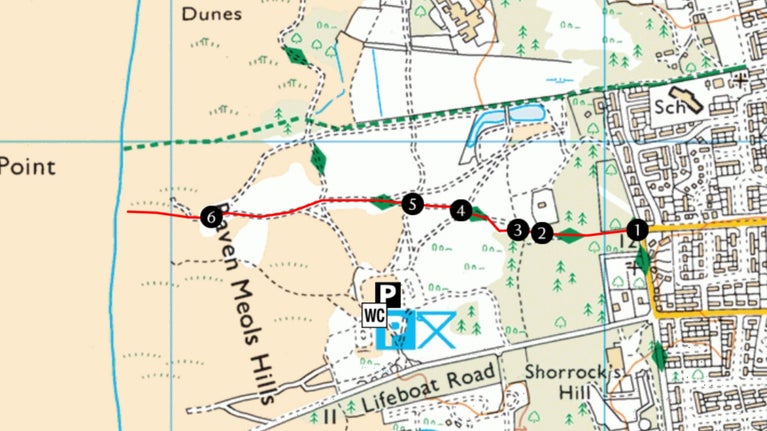
Formby Kirklake Path Map | © Crown copyright and database rights 2013 Ordnance Survey
Get in touch
National Trust Formby Countryside Office, Blundell Avenue, Formby, Liverpool, L37 1PH
Our partners

We’ve partnered with Cotswold Outdoor to help everyone make the most of their time outdoors in the places we care for.
